Abstract
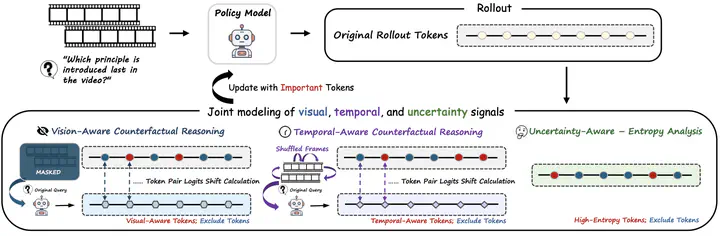
Reinforcement learning (RL) has shown strong potential for enhancing reasoning in multimodal large language models, yet existing video reasoning methods often rely on coarse sequence-level rewards or single-factor token selection, neglecting fine-grained links among visual inputs, temporal dynamics, and linguistic outputs, limiting both accuracy and interpretability. We propose Video-KTR, a modality-aware policy shaping framework that performs selective, token-level RL by combining three attribution signals: (1) visual-aware tokens identified via counterfactual masking to reveal perceptual dependence; (2) temporal-aware tokens detected through frame shuffling to expose temporal sensitivity; and (3) high-entropy tokens signaling predictive uncertainty. By reinforcing only these key tokens, Video-KTR focuses learning on semantically informative, modality-sensitive content while filtering out low-value tokens. Across five challenging benchmarks, Video-KTR achieves state-of-the-art or highly competitive results, achieving 42.7% on Video-Holmes (surpassing GPT-4o) with consistent gains on both reasoning and general video understanding tasks. Ablation studies verify the complementary roles of the attribution signals and the robustness of targeted token-level updates. Overall, Video-KTR improves accuracy and interpretability, offering a simple, drop-in extension to RL for complex video reasoning.